Executive Summary
February 2026 marked a significant inflection point for Mexico’s mining policy environment within the broader North American geopolitical and trade architecture. Three concurrent developments — (i) the recent cancellation of 1,126 mining concessions, (ii) the announcement of a U.S.–Mexico Critical Minerals Action Plan, and (iii) the launch of a Mexico–Canada strategic economic minerals focused action plan — collectively signal a structural reordering of regulatory enforcement, supply chain policy, and continental investment alignment.
This executive-level report provides a detailed legal, economic, and strategic analysis of these developments, evaluating implications for operators, investors, financiers, and cross-border stakeholders. The convergence of stricter domestic enforcement and heightened continental supply-chain diplomacy creates both heightened compliance risk and strategic opportunity for well-positioned projects.
Chapter 1 — Cancellation of 1,126 Mining Concessions in Mexico
1.1 Regulatory Context
On February 12, 2026, Mexican President Claudia Sheinbaum announced the cancellation (“recovery”) of 1,126 mining concessions covering approximately 889,000 hectares. The measure was publicly framed as an enforcement action targeting non-payment of mining duties, failure to comply with reporting obligations, and overlaps with Protected Natural Areas (ANPs).
This development must be interpreted within the broader reform trajectory of Mexico’s mining legislation since 2023–2024, including strengthened environmental oversight, enhanced state discretion in concession administration, and political emphasis on territorial sovereignty.
1.2 Legal Grounds and Administrative Mechanisms
Under Mexican mining law, concessions may be cancelled for failure to pay duties, failure to submit annual expenditure work and statistical reports, or other material non-compliance. The February 2026 announcement demonstrates an assertive application of these statutory tools at scale.
Notably, the public communication highlighted that 713 concessions overlapped with Protected Natural Areas, underscoring the integration of environmental policy with title administration. While overlap does not automatically invalidate title rights, it increases regulatory scrutiny and operational uncertainty.
Each cancellation procedure should be analyzed independently considering the specifics of each particular case, in order to determine the best action or legal defense to secure or recover the concessions from the cancellation procedure, and if possible remedy the non-compliance that motivated such disciplinary proceedings.
1.3 M&A and Financing Implications
The cancellation wave materially shifts due diligence standards in mining transactions. Investors and lenders should now treat compliance documentation — payment receipts, report filings, and regulatory acknowledgments — as closing-critical deliverables.
Enhanced representations and warranties related to concession standing, duty payments, and reporting compliance are expected to become standard in financing agreements and acquisition documentation.
1.4 Strategic Risk Assessment
- Increased enforcement unpredictability.
- Elevated political sensitivity for projects near protected areas.
- Greater administrative discretion in title validation.
- Potential chilling effect on speculative land banking.
Chapter 2 — U.S.–Mexico Critical Minerals Action Plan
2.1 Strategic Objectives
Announced February 4, 2026, by U.S. Trade Representative Ambassador and Mexico´s Secretary of Economy, the U.S.–Mexico Critical Minerals Action Plan seeks to strengthen continental supply chains by identifying priority minerals, aligning geological cooperation, and evaluating trade-policy tools such as border-adjusted price floors.
The plan must be understood within the context of geopolitical competition over rare earths, lithium, graphite, copper, silver and other inputs essential to clean energy, defense, semiconductors, and advanced manufacturing.
2.2 Trade Policy Dimensions
The potential exploration of price floors represents a notable shift toward active trade intervention to stabilize domestic and allied mineral supply chains. If implemented, such measures could materially influence offtake contracts, project valuation models, and cross-border pricing mechanisms.
2.3 Industry Perspective — CAMIMEX Analytical Review
CAMIMEX characterizes the Action Plan as a strategic opportunity for Mexico to consolidate its industrial role in North America. The association highlights Mexico’s production of at least a dozen strategic minerals critical to electromobility, digitalization, and renewable energy.
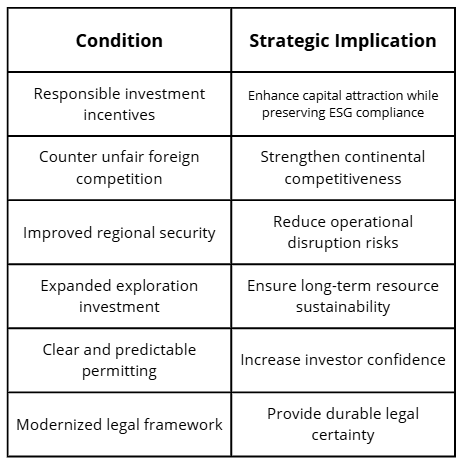
However, CAMIMEX emphasizes that realizing this opportunity requires enabling conditions that strengthen competitiveness and regulatory certainty. The industry estimates potential investments exceeding USD 43 billion over six years if such conditions are satisfied.
CAMIMEX — Enabling Conditions (Analytical Table)
2.4 Strategic Assessment
The success of the Action Plan depends not only on bilateral diplomacy but on Mexico’s internal regulatory coherence. Without permitting predictability and security stabilization, supply chain integration goals may remain aspirational.
Chapter 3 — Mexico–Canada Strategic Action Plan (February 2026 Trade Mission)
3.1 Diplomatic Context
The Team Canada Trade Mission in mid-February 2026 coincided with announcements of a forthcoming bilateral action plan aimed at expanding trade, reducing regulatory obstacles, and facilitating investment in minerals and infrastructure.
3.2 Economic and Investment Dimensions
Given Canada’s significant footprint in Mexico’s mining sector, the proposed action plan may streamline investment corridors and reduce administrative bottlenecks affecting Canadian issuers.
3.3 Forward-Looking Outlook
- Potential structured government facilitation mechanisms.
- Alignment of ESG standards across jurisdictions.
- Integration of port and logistics infrastructure into mineral strategy.
- Enhanced continental positioning ahead of USMCA review.
Conclusion — Convergence of Enforcement and Geopolitics
Mexico’s cancellation of concessions, combined with enhanced continental critical mineral diplomacy, reflects a dual-track evolution: stricter domestic regulatory enforcement alongside intensified North American strategic coordination.
For sophisticated operators and investors, this environment presents heightened compliance demands but also significant strategic upside for projects aligned with critical mineral priorities and continental supply chain integration.